PreK-6th Grade Level.
Quinn Ramirez.
2/8/26.
INFO 5421.
Title of Book
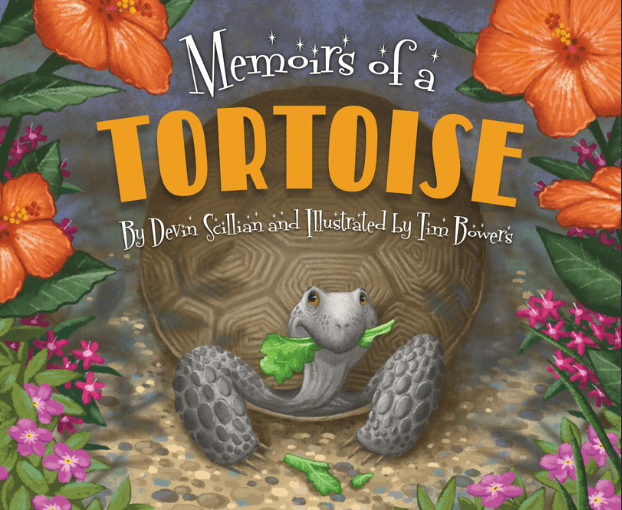
Memoirs of a Tortoise.
By Devin Scillian. Illustrated by Tim Bowers.
Book Cover Picture
Genre or category
Picture Books. Animals. Death. Grief. Children’s. Nature. Friendship. Pets. Loss.
Target Age Group
5 Years old—8 Years old.
Summary
This is the story of a tortoise named Oliver who lives with his “pet” human Ike. Oliver is content with his life with Ike, enjoying their home in the garden. But then one day, Ike passes away. So, Oliver goes to the wisest tortoise he knows, his mother, to find out what to do with his life now that Ike is gone. (Winner of a Texas Bluebonnet).
Justification
I chose this title because I love animals of all kinds and wanted to find a Bluebonnet award-winning book. I also have a fascination for turtles and tortoises. However, As I read it, I liked how the book started off happy, and how it was told from the tortoise’s perspective. It also intrigued me how the book goes through change and loss. I especially like how Oliver the tortoise find hope again. It also goes to the children and the audience that nothing lasts forever. We may outlive our pets, but that doesn’t mean we can forget the good times we had. Especially since Oliver gets adopted by Ike’s son tend at the end, and Oliver realizes he still is a lucky tortoise after all.
Evaluation
I feel one of my favorite things about the book is the setting. The entire story takes place in a garden, complete with exotic plants like sycamore and hibiscus. These plants and gravel paths help give the world a sense of beauty and wonder. I feel that help gives the story a more natural feeling. It lets us experience the world as much as Oliver the tortoise does. While he goes on his journey, we do too. Even if Oliver looks like he’s traveling across the street, it feels like a long distant journey to him. We also see the world shine its light on Oliver again once Ike’s son Ted takes care of him. We get to see the bright colors return to the book as Oliver’s life feels whole again.
Another unique thing about this book is the illustration. The style is very detailed, especially on the plants in the garden. There is even a page where Oliver is walking towards his mother, and we get to see the garden she lives in. There are no words, just a skyward view of the plants, decorations, a birdbath, and all other things that make the garden beautiful. The author does a good job drawing the tortoises. There are lines and textures on their bodies, from their shells to their scales. It not only shows the longevity of our tortoises but also shows the tortoises in a way that makes them appeal to children. We get to see Oliver emotions, and the illustrator helps Oliver express himself in a way only a tortoise can. He has no teeth, but he can sure smile.
This book is recommended for children ages 5-8 but can be read by people of all ages. This book may mention themes of death and loss which most children may find difficult to read. It is best recommended for this book to be read with an adult for the first time. Despite all that, the book is still an engaging read. The book is a roller coaster of emotions. From the sunny lights of the beginning, then it takes a surprising turn at the middle, and then bring back hope by the end. I feel this book should be read by anyone who likes animals, and anyone who has a pet. To show that even as your pet goes away, they will always have a place in your heart.
References
Scillian, D (2020). Memoirs of a Tortoise. (T. Bowers, Illus.). Sleeping Bear Press.
Title of Book
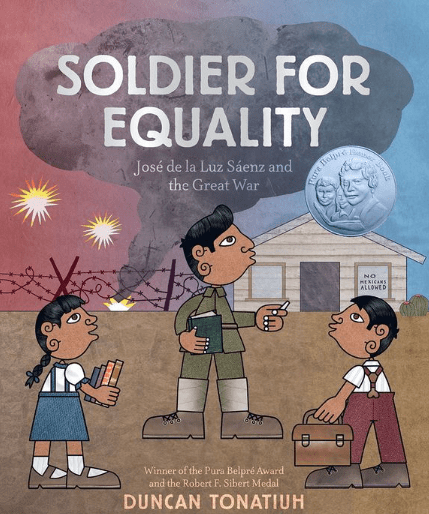
Soldier for Equality. Jose de la Luz Saenz and the Great War.
Written and illustrated by Duncan Tonatiuh.
Book Cover Picture
Genre or category
Historical. Biography. Civil Rights. Mexican-American history. Latinx. War. Social Justice. Nonfiction.
Target Age Group
Ages 10-13.
Summary
This book tells the story of Jose de la Luz Saenz, or Luz for short. Throughout the course of his life, Luz has experienced discrimination and no respect. Despite everything he does, such as becoming a teacher, he gets no respect or credit because he is Hispanic. So, he ends up joining the army during World War 1 to fight for his country, and to give more hope and respect to his people. (Winner of a Pura Belpre award).
Justification
I chose this book because I am familiar with Duncan Tonatiuh’s work, as well as his art style, however, I have never seen a story like this. I always believe that everyone should be treated nicely, and the credited for what they do. So it was amazing to see Luz’s struggle and how he overcomes them in the end. How he never give up hope, or does he let anyone define who he is based on the color of his skin or where he came from. OI also took Mexican-American studies, so it was interesting the see the early roots of Hispanic civil rights, as well as the struggles and obstacles that many Latinx people had to face to have a better life.
Evaluation
One of the most interesting things about the book is the art style. Inspired by Aztec and ancient indigenous art, Tonatiuh uses an art style unique to his people and his ancestry. Furthering the story’s theme of being proud of your heritage. Not only that, but the art style works for this story because it deals with a major conflict. Despite being set centuries after the Aztecs fell, the author still draws the characters like warriors, fighting for their homeland and the people they love. The style established the Mexican people as proud and strong, willing to face any threat that comes in their way. But also, as people telling their story. We see a Latino story told from a Latino’s eyes.
Another interesting thing about this story is about its themes of fair treatment. Luz was born in the states, He goes to school, gets a job, and has a family. So why isn’t he given the same respect as white Americans? Why do they get to call him names and treat him terribly? But Luz’s father tells him to never be ashamed of his background, or where he comes from. Luz even learns French because of its similarities to Spanish. This allows him to learn more about what’s happening during the war and interprets French codes. However once he comes home, Luz sees that Mexican Americans are still being mistreated! So, he meets with fellow veterans of the war and creates the League of United Latin American Citizens. So that Latinos would get the respect they deserve, and have their children grow up in a world without hate or judgement.
Recommended for students ages 10-12. But can be read by anyone who is Latinx or wants to understand Hispanic American History. This book is also good for people who want to learn about civil rights and the struggles of Hispanic Americans. This book also has line in Spanish, can be used to help learn the Spanish language. However, this book has themes of war, violence, discrimination, and even has a racial slur. (“Greaser”). First time reading should be with an adult, so that way the reader can understand why that word is not acceptable, and why you shouldn’t call people that word. The book also has strong morals about self-worth, as well as themes of hard work. This can help inspire readers to do more, and to be proud of their own background.
References
Tonatiuh, D. (2019). Soldier for Equality. (D. Tonatiuh, Illus.) Abrams Books.
Title of Book
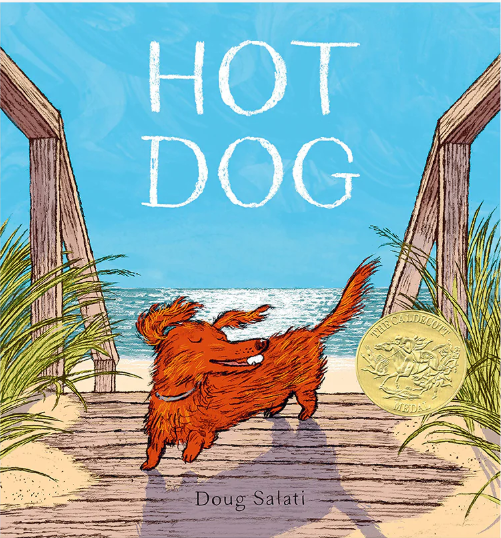
Hot Dog.
By Doug Salati.
Book Cover Picture
Genre or category
Children’s. Animals. Picture Books. Dogs. Summer. Beach. Fiction. Adventure. Storytime. Realistic Fiction. Nature.
Target Age Group
Children that are 4-10 years old.
Summary
A dog and his owner have a long hot day in the city. So, they decide to get away from it all. They take a vacation to a nice beach on a little island, enjoying the heat at a safe place. (Winner of a Caldecott Medal).
Justification
I chose this book because of the art style of the cover, as well as the image of the red dog. However, what drew me in was the clever illustrations, and the tone of the book. Sometime, life stresses us out, so we need to find a place where we can unwind. A place where we can reflect and remember even after we go home. That was an interesting message, and I feel that it is a good message to share with kids. Not only that, but the book was fun to look at.
Evaluation
The first thing I will talk about is the art style of the book. The shapes, colors and texture help establish the tone of the book. Lighthearted and wonderous. In the beginning, we see the crowded, busy city surrounded by noise, crowds and trouble. We can tell because the page is crowded with objects, shapes, and sound effects. Thus, furthering the dog’s irritation, as well as his heat. This also makes the transition to the cool clear beach even more satisfying. We see the clear sand, the soothing waves, and the decorative seashells illuminate the pages. Then we end up with the dog and his owner, going to bed, remembering the soothing rhythm of the waves as they drift to sleep. We even see exotic animals like seals in the dreams of the dog.
One other thing that caught my eye was the simplistic language. We use short, sweet sentences, to help enhance the illustrations. A perfect example of show, not tell. We hear little words to see how the dog is thinking, and even then, we can see why he’s thinking that. The dog is hot, and he’s annoyed by the hectic sounds. But by the time his owner takes him to the beach, we see him stop talking, finally at peace. As he plays along the beach, the audience sees him do it, and we don’t see any text until the long way home. By doing this, we see the dog reflect and enjoy himself as he drifts off to sleep.
Can be read by people of all ages but recommended to children ages 5-10. The simple illustrations might be off putting to some, and I recommend telling an adult if there are any problems with the illustrations. The book is very lighthearted and has positive morals. It can be recommended by anyone who is having a stressful day to show them that sometimes, it’s ok to take a break, and breathe in fresh air. This book is good for anyone who likes dogs or likes going to the beach. Basically, this book is for everyone who wants to get away from it all, and to take it easy whenever the hectic sounds of the city cause trouble.
References
Salati, D. (2022). Hot Dog. (D. Salati, Illus.). Borzoi Books; Alfred a. Knopf.
Title of Book
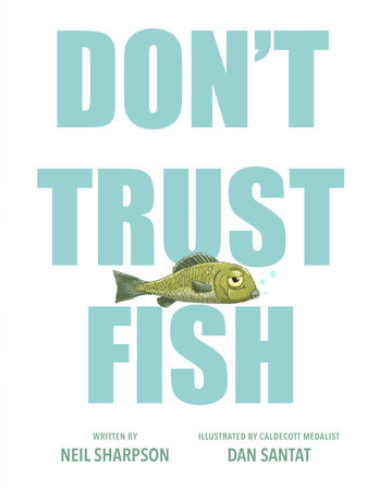
Don’t Trust Fish.
By Neil Sharpson.
Illustrated by Dan Santat.
Book Cover Picture
Genre or category
Humor. Animals. Fish. Children’s. Story Time. Art. Nature. Juvenile. Satire.
Target Age Group
Children that are 3-7 years old.
Summary
This book warns of the evils of fish. Their strange shapes, their peculiar fins. What evil lies behind these creatures of the deep. (Winner of a Texas 2×2).
Justification
I chose this book because I love animals, and the title alone drew me in. Don’t Trust Fish, why? I knew I was in for a treat. I also love books, humor and ridiculousness. How it goes out of its way to dehumanize fish. It is also funny to think of fish as dangerous because all they do is just swim.
Evaluation
One thing I like about the book is the writing and the humor. It goes to show you how normal other animals are, but then once we get to fish, the tone immediately changes. Describing fish and vicious dangerous creatures. How they have no rules or logic. They come in all shapes and sizes. Some live in freshwater and some in saltwater. The boom goes out of its way to show how vicious fish are, and how they eat poor innocent creatures like crabs. It shows how evil fish are and how noble crabs are. The reasoning against fish is hackneyed and ridiculous. Then it reveals it was all written by a crab. Showing how you shouldn’t jump to conclusions, and how you shouldn’t fall for information that seems judgmental.
The book’s art style also adds humor and hysteria to the book. Each of the books has a unique drawing for each fish and creature. It gets quite funny near the end where there is bold, colored text yelling to distrust fish. Each fish is unique and is drawn in a cartoonish way. Plus, all the non-fish animals are drawn in a realistic way, which creates contract with the ridiculous fish. There are pages of bright white with simple black text, while other pages are blue and green, reflecting the fish’s underwater home. Overall, I feel the books’ colors and style help enhance the humorous tone the book sets.
Recommended for children ages 3-7 but can be read by children of all ages. The art style is very reminiscent of cartoons, and can draw the young readers in. Not only that, but the books’ humor is universal. However, some fish may be too scary for young people, especially the sharks. So, I feel an adult should be present during the first readings. I recommend this book to anyone who is interested in animals, fish, the ocean deep, or anyone who just wants to have a good laugh. Basically, it is a hilarious, satirical tale of the creatures under the sea.
References
Sharpson, N. (2025). Don’t Trust Fish. (Santat, D. Illus.). Dial Books for Young Readers; Penguin Random House.
Title of Book
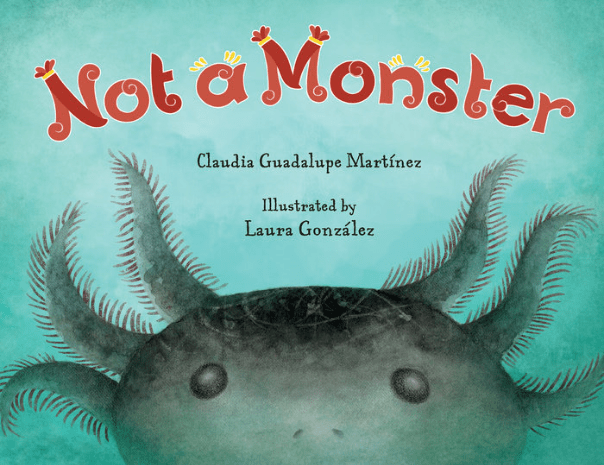
Not a Monster/ No Es un Monstruo.
By Claudia Guadalupe Martinez.
Illustrated by Laura Gonzalez.
Book Cover Picture
Genre or category
Nonfiction. Folklore. Animals. Amphibians. Mexico. Picture books. Children’s. Spanish Literature. Nature. Environment. Storytime. Conservation.
Target Age Group
For children 3-7 years old.
Summary
This book tells the story of the axolotl. A strange looking amphibian from Mexico. We look through the life cycle of the axolotl, and how important they are to the Mexican people.
Justification
I chose this book because it is a book for Hispanic Americans, and it tells of an animal most people haven’t even heard of. I also had a fondness for reptiles and amphibians. Not only that, but it was also the favorite animal for my cousin, as well as many other children of her generation. So, I wanted to see a children’s book based on them. Not only that, but the more children read about axolotls, the more effort can be made to protect them.
Evaluation
The book has a unique writing style. Going back and forth between Spanish and English. This is good because it comes naturally in the writing, and in the text. It helps describe the unique features of the axolotl and its habitat and does so in a way children can understand. The special words are highlighted in colors, and the pages help reflect these colors. Not only that, but it can help our readers learn Spanish as much as English. Because the Spanish words use familiar colors and pictures to help describe what they mean. There is even a vocabulary at the end to help English speakers understand which Spanish words are used. This book is very helpful in learning a new language, and it can be read by speakers or both Spanish and English without any problems. Breaking the barriers of words to tell of a unique and beautiful creature.
The books’ illustrations are very beautiful and artistic. The art helps show the axolotl as a wonderous creature. It shows its growth from egg to tadpole, then finally growing legs and arms under a deep blue river. Then it shows the lilies and the pink flowers that grow on them. With unique shades of blue, green, and yellow, the axolotl’s habitat is a haven in the wilds. Focusing on traditional Aztec art combines with watercolor inspired art, the book is a treasure to look at. Readers will be enthralled by all the plants and animals that decorate the books setting. Not only that, but the images match the simplistic text, showing the colors highlighted, making the underlined Spanish words easier to understand. The art style shows the axolotl as a mysterious, yet adorable creature. A creature with leaning about, and worth protecting.
Recommended for children ages 3-7 but can be read by children of all ages. I recommend this book to anyone who wants to learn more about axolotls, and the beautiful habitat they inhabit. I also recommend this book to anyone who wants to learn Spanish, English, or both. It allows the user to learn both languages without one language undermining the other. To show that all people deserve to learn and read about these amphibians. This book is quick to read, but it is a treasure to look through. This book helps explain that you shouldn’t judge a creature by how it looks, and how its beauty can be seen within. This book is also good for children who want to learn more about obscure animals and endangered species. The more these species are read or talk about, the more they can be preserved.
References
Martinez, C.G. (2023) Not a Monster/No es un Monstruo. (L. Gonzalez, Illus.) Charlesbridge.
 Ramirez Book Blogs
Leave a comment