Pre-K–6th Grade Level.
Quinn Ramirez.
4/4/2026.
INFO 5421.
Ghost boys.
By Jewell Parker Rhodes.
Genre or category
Realistic Fiction. Social Justice. African American & Black People & Places. Children’s books.
Target Age Group
Ages 8-13 years old. Grades 5-8.
Summary
This is the story of a young boy named Jerome, who is surprised to find out that he is dead. Shot down by a police officer, he watches as his family is devastated by their son’s death, as well as the community outrage over the unjustified killing of an innocent boy. Meanwhile, Jerome meets another ghost named Emmet Till, who died in similar circumstances. Jerome also meets Sarah, the timid daughter of the officer who shot Jerome, and learns about what has happened in her home life after the incident.
Justification
I chose this book because of how it depicts the current racial dynamics in America. It shows how innocent individuals like Jerome can fall victim to an unfair system. The narrative underscores that racism continues to pose threats to African Americans, often leading to lives being lost or destroyed with little or no evidence. As the story progresses, Jerome’s flashbacks shift between his life and his sudden death, shedding light on the events that caused his murder and the neighborhood he inhabits. I picked this book because I believe it’s crucial for fostering better race relations in America, offering a fresh perspective on police brutality and systemic racism.
Evaluation
I shall be evaluating the book’s tone and mood, as well as its status as a banned book.
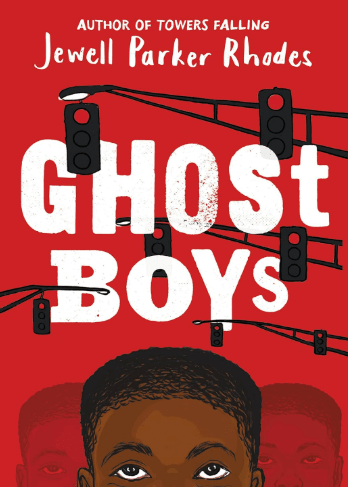
One of my initial focuses will be on the tone of this book. ‘Ghost Boys’ is primarily narrated from Jerome’s perspective. He wakes as a spirit, completely invisible to almost everyone. Especially those in his family. He can only watch as his loved ones cry, while the man responsible for his death tries to defend himself. The author’s portrayal is unflinching, showing how unfairly Jerome was treated and emphasizing that he was just a typical kid shot simply because of his race. To depict the many losses Jerome faced due to a single police officer’s mistake, we see him feeling distressed and confused, immersed in the spirit world, observing his family and community mourn him and call for justice. The tone also vividly depicts Jerome’s neighborhood—an almost ghetto-like area of Chicago. When he encounters Sarah, he perceives a room filled with soft pillows and stuffed animals. While some people sleep peacefully, others endure hardship and fear. Jerome’s home environment further exposes his vulnerability. The perception of hoodlums and gangs in the neighborhood influences the officer’s judgment, and the author makes this clear. She expresses the anger and despair felt as many young African American men like Jerome are lost too soon, highlighting ongoing issues of race, class, and morality.
The second key aspect of the book I will analyze is the mood and atmosphere. The overall tone is somber. Readers empathize with Jerome as he tries to make sense of his death, sharing his desire for acceptance. We see a young boy lost too soon due to a foolish misunderstanding. The audience is immersed in Jerome’s point of view, feeling his sorrow as he is unable to lead a normal life, trapped as a restless spirit. We also sense his anger and grief over his life being taken by a man who shows no remorse. This prompts the audience to question: Why did Jerome have to die? Why do others perceive him as intimidating? Does Sarah suffer because of her father’s sins? Is the justice system flawed? These questions are raised throughout the book, shocking the audience as it exposes the darker underside of American law enforcement.
I want this book to be part of my Banned and Challenged Books category because of its provocative subject matter. Featuring scenes of police brutality, Black Lives Matter, and racial violence, it has been banned in states like California and Florida. Even author Jewell Parker Jones was taken aback by the ban, noting that the book seeks to illustrate the “difference between racism and unconscious bias” (Wilton, 2023). Its purpose is to promote understanding, compassion, and education to combat hate, fear, and violence. Through Jerome’s story, readers can learn how to work for reform instead of supporting injustice, speak out instead of remaining silent, and find solutions to bridge the racial divide. This aims to help future generations live free from fear or sadness caused by their skin color or neighborhood.
References
Jones, J.P. (2018). Ghost Boys. Hachette Audio.
Ghost Boys. Jewel Parker Rhodes. https://jewellparkerrhodes.com/children/books/ghost-boys/
Wilton, S. (2023, Mar 1). Ghost Boys Banned. Jewel Parker Rhodes. https://jewellparkerrhodes.com/children/ghost-boys-banned/
Radiant Child: The Story of Young Artist Jean-Michel Basquiat
Written and Illustrated by Javaka Steptoe.
Book Cover Picture
Genre or category
Art. Culture. Juvenile Nonfiction. African American studies. Hispanic American Studies. Puerto Rican American stories. Biography.
Target Age Group
Ages 5-7. Grades K-2nd Grade.
Summary
Jean-Michel is a boy who loves art. A boy who paints outside the line and is determined to be famous one day. But when his mother ends up leaving home, and he gets injured in a car accident, Jean Michel uses art to heal and then make his mark in New York City. Through the love of his mother and his desire to paint, Jean-Michel can make a name for himself.
Justification
I chose this book because it’s visually engaging, featuring vibrant colors and styles. The detailed artwork beautifully depicts both African American and Hispanic American art. It also captures the wonder and scale of New York City, portraying it as a land full of color and beauty. I also believe it effectively tells Jean-Michel’s story, allowing readers to see the world through his perspective. Inspired by his unique artistic style, the book helps illustrate the struggles and inspirations of a young artist, emphasizing that beauty and creativity can come from anyone.
Evaluation
For this review, I will be evaluating this book’s color, art style, and status as a Coretta Scott King Book winner.
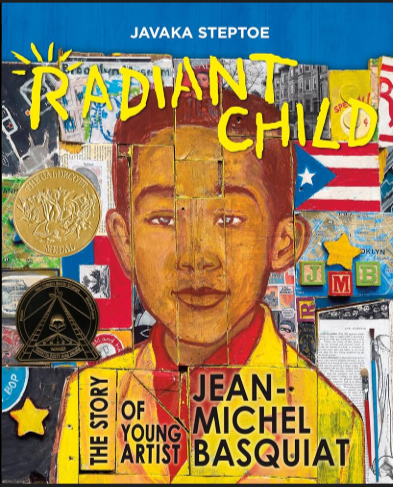
The first thing I shall be evaluating is the color. The author puts a very precise focus on the colors he uses. Such as using bright green, blue, and yellow to show a sunny day in Brooklyn. The author also uses brown to describe the people in Jean Michel’s life. Jean Michel is Puerto Rican and African American. The Brown skin helps show his heritage, as well as connect him with his family. The book also shows red and black when his mother is taken away, leaving Jean-Michel with mental illness. These colors help the reader see the heartbreak Jean-Michel is going through and how scared he feels on the inside. The color black is also used in a variety of ways. Jean-Michel wears a black jacket, separating him from the crowd. Then, on black canvases, he starts making his art. Helping us establish Jean-Michel as someone who stands out from the crowd, as well as helping him stand strong as an artist. Overall, I feel that the colors are one of the aspects of this book that help show its unique charm.
The second thing I shall be is the art style. The book is inspired by traditional art on the streets of New York. They are not as fancy as the Renaissance artists, nor are they as detailed as the ancient Greeks. But rather vibrant, wild, and free. The illustrations are like a collage or a type of abstract art. With rich colors stretching across the pages, various shapes and images help bring the neighborhood of Brooklyn to life. To show how an artist’s vision can spark from anywhere, and that art is truly from the eye of the artist. We see as Jean-Michel views the world around him. We also have unique variations from the text. With words like “Artist”, “Mi Amor”, and “New York City” written in a different font from the other words, we can see the words that have the most meaning to Jean-Michel, and by doing so, we can understand how his art illuminates the pages of this book.
I chose this book to be a part of my Coretta Scott King Winners. I chose this book because it stood out from all the other entries. The cover jumped out at you and welcomed you into the wondrous world of Jean-Michel’s art. Not only that, but we see the life and times of a young African American/Latino artist. The audience can see all the struggles he has to go through, as well as how he sees his neighborhood. This book also has a strong portrayal of family members who go through mental illness. We read that Jean-Michel’s mother, Mathilde, the source of his inspiration, must leave because of her diminishing mental health and well-being. We feel, as Jean-Michel does. We see him continue to help his mother and continue to use his art to honor her. To show that she is not alone and will always have her creative little boy by her side.
References
Steptoe, J. (2016). Radiant Child: The Story of Young Artist Jean-Michel Basquiat. (J. Steptoe, Illus.) Little, Brown and Company.
When Green Becomes Tomatoes: Poems for All Seasons.
By Julie Fogliano.
Pictures by Julie Morstad.
Book Cover Picture
Genre or category
Nature. Poetry. Children’s literature. Nonfiction.
Target Age Group
Ages 4-8. Prek-2nd Grade.
Summary
A group of children describes the changing of the seasons. How the rain falls, how the flowers grow, and the feelings they have during the changing times. These children see the world change around them and think of their favorite parts of these sudden shifts in the weather.
Justification
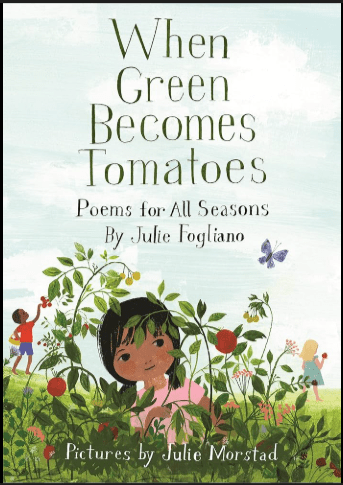
The reason I chose this book was the illustrations. I loved the simplistic watercolor of each page and how it shows each of the seasons. The changes in color and style shift as the book progresses. From the white snow of winter at the beginning, to the colorful flowers of the Spring, to the bright, clear waters of the summer, and ending with the shifting leaves of fall. I feel each of these pages does a perfect job in showing how the children feel about their favorite season, and how the world is changing towards them.
Evaluation
For this review, I will be evaluating this book’s art style, scale, and poetry.
The first thing I shall be evaluating is the book’s art style. Each page of this book is uniquely illustrated and helps represent each of the four seasons. Especially when it comes to the plants of this book. They range from plentiful flowers of spring to the wide and tan beaches of summer. Each background is decorated with as many drawings as can be. This gives the book a sense of wonder and scope. Not only that, but it is done through the drawing style of a child. Full of simplicity and detail. I feel this helps give poems more strength in this novel, because the book shows the beautiful sights of nature that inspired these simple acts of poetry. Not only that, but this book draws the readers in and can put them in a serene background full of bliss and beauty.
The book’s scope is another aspect I will evaluate. The book helps fill the reader with a sense of exploration. From within this book about seasons, each page also shows wide open spaces. Areas full of lush vegetation, and the children who are skipping through them. Just goes to show how small we really are compared to the whole world. Not only that, but for each time of year, there is a unique background. Winter with its blankets of white snow. Spring with its fields of flowers and bees. Summer with its wide, sandy beaches and blue, starry nights. Finally, there is autumn, full of its ever-changing leaves and flowing sands.
I chose this book for my poetry analysis because its poems of nature and curiosity drew me in. The poem each child tells in the story helps show the innermost feelings about the world around them. They talk of how beautiful blooming flowers are. They talk of the calm of the lake. These poems help portray the majesty of nature as the children are experiencing it. They help create a sense of emotion. The children’s poems show how amazing each of the seasons is, and what it means to each of them. These poems offer perspective and feeling on each of the book’s pages. I feel these poems help enhance the illustrations and give them life. Overall, I feel the poems do a perfect job in helping understand the themes of the book, as well as capturing the beauty of each of the illustrations.
References
Fogliano, J. (2016). When Green Becomes Tomatoes: Poems for All Seasons. (Morstad, J, Illus.) Roaring Book Press.
This Is How We Talk: A Celebration of Disability and Connection.
Written by Jessica Slice and Caroline Cupp.
Illustrated by Kayla Harren.
Book Cover Picture
Genre or category
Disability. Children’s. Communication. Neurodivergence.
Target Age Group
Ages 4-8. Grades Prek-3rd grade.
Summary
You don’t just need to say, “I love you.” Many special children have their own way of telling their parents how much they care. Even if they are considered disabled, they shouldn’t be ashamed because this is how they talk.
Justification
I chose this book because I wanted to find a book about disabled and neurodivergent children, as well as how they act. I also wanted to see all the ways they communicate with their loved ones. So, I found this book, and it is a positive, upbeat take on how children with special needs interact with their family, and how not to be ashamed of it.
Evaluation
For this review, I will be evaluating this book in terms of positive language, illustrations, and diversity.
Firstly, I will talk about the positive language of this book. The book is uplifting and compassionate. It creates a welcoming tone and mood for the reader. This helps create a sense of belonging for all people, regardless of background or physical limitations. I feel this helps with the theme of the book because the tone is meant to show the reader that you cannot change the way people act, nor judge people for something they are born with. Not only that, but the tone takes an exciting approach, reminding the reader to be proud of who they are, no matter what. Especially with people with disabilities. It is saying there is no shame, and that they should be happy to be themselves.
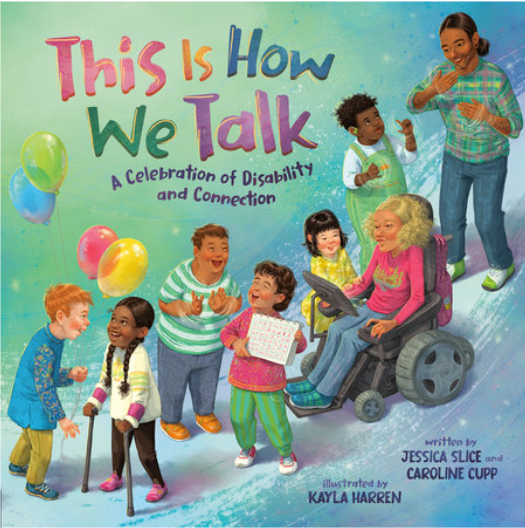
The illustrations of this book are unique, too. They are very detailed and almost realistic. Not only that, but it physically shows all the different kinds of people coexisting together. The illustrations also take great care in portraying how these children show love. Such as with hand holding, writing it out, using sign language, or even an iPad. Each character is also given an aura that shines and has a different color for each person. Thus, creating the idea that everyone is unique. All people have their own special energy. The book attempts to transcend all barriers within people and be able to convince the audience that this is how some members of society act. So, we should be able to understand how to help them and treat them equally. The Illustrations help remind us that everyone is different, but everyone still has the right to be themselves. If they need help, we shall be there for them.
I chose this book for my Disabilities and Diversity topic. I chose this book because I wanted to find a book that helps provide a theme of acceptance for everyone. I feel this book does that perfectly. It shows children who use American Sign Language (ASL), people in wheelchairs, people with headphones, and all kinds of people who are considered disabled. But it doesn’t paint them in a negative light. Far from it. The book attempts to transcend all barriers within people and be able to convince the audience that this is how some members of society act. So, we should be able to understand how to help them and treat them equally. To be a better society, we need to understand all people. Each person talks or expresses themselves in their own way, and this book shows that some ways of speaking are more different than others. But through understanding and time, we can come to learn all forms of communication, even those that are not spoken but rather are done physically. Whether it be a hug, a device, or even a smile.
References
Cupp, C. & Slice, J. (2025). This Is How We Talk: A Celebration of Disability and Connection. (K. Harren, Illus.) Penguin Random House.
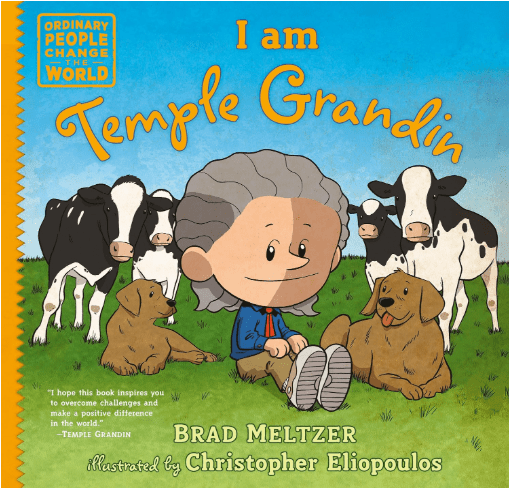
I am Temple Grandin.
By Brad Metzler. Illustrated by Christopher Eliopoulos.
Book Cover Picture
Genre or category
Nonfiction. Biography. Children’s literature. Science. Disabilities and Differences.
Target Age Group
Ages 5-9 years. Grades K-4th Grade.
Summary
This is the story of Temple Grandin. The renowned scientist who helped discover new ideas about animal care. All thanks to being autistic her whole life.
Justification
I chose this book because I wanted to know more about Temple Grandin, and I wanted to honor a famous scientist on the autism spectrum. In honor of Autism Acceptance Month. When looking through a biography, I wanted to find someone who changed the world without giving up too much of themselves.
Evaluation
For this review, I will be evaluating this book’s illustrations, portrayal of autism, and the biographical aspects.
This book’s illustrations are simple yet endearing. It’s almost like a little comic book. It matches the text of the book, as well as expands on it. Such as showing Temple’s sensitivity, as well as her own interests. Not only that, but it also presents a visual way of what Temple thinks. That way, we can understand her, and nothing much needs to be said. These illustrations are also charming and add a sense of fun to the story. Not only that, but the art style helps this book stand out from other biographies by giving it a cartoonish feel. Thus, making the book more interesting to learn about Temple, as well as why she was important.
This book’s portrayal of autism is unique. Many symptoms of Autism are shown with Temple, such as trouble with eye contact, unemotive talking, and even her sensitive nose. By doing this, we can learn common traits in autism, as well as how relatable they can be. By doing this, more people can become more aware of autism and how to interact with the symptoms. Being someone with Autism, I can relate to Temple, such as being sensitive or having trouble with eye contact. So, I now have more knowledge of my behavior, as well as learnt how other people with autism have learnt to embrace it rather than hide it.
I chose this book for my biography because I wanted to find someone famous who was autistic for autism acceptance month. I also wanted to shed light on Temple Grandin and her contributions to agriculture and science. These were her areas of expertise. Not only that, but I feel that Temple is a good role model. She inspires people to be unashamed of who they are and always do what they’re best at. I feel that Temple Grandin is a motivational figure that all people should know about. Someone whose gifts should have made Temple into an outcast instead put her on the path of innovation. She was a cattle chute operator who learned new ways of calming down animals. She was able to understand the perspective of the cattle because she applied their technique to herself. She applied the right amount of firm pressure and was able to hypothesize what the cattle were feeling. In doing so, Temple found ways to help build pens in which the cattle became more accustomed to. She saw that these animals think and feel the same way humans do. So, I wanted to honor her discovery and perseverance. It just goes to show that you don’t have to be “normal’ in order to do extraordinary things.
Meltzer, B. (2023). I am Temple Grandin. (C. Eliopoulos, Illus.) Rocky Pond Books.


Leave a Reply