Ramirez Book Chat 3.
7th-12 Grade Level.
Quinn Ramirez.
4/26/26.
INFO 5421.
Title of Book
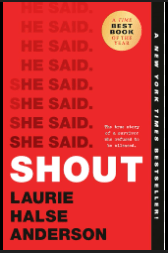
Shout by Laurie Halse Anderson.
Book Cover Picture
Genre or category
Memoirs, Poetry, Nonfiction, Novel in Verse, Young Adult.
Target Age Group
Ages 14 and up. (Grade 9 and up).
Summary
In this novel in verse, author Laurie Halse Anderson shared her life’s history, as well as her experience being sexually assaulted. All the while showing how little has changed when regarding women’s and rights.
Justification
I chose this book because I wanted to find a novel in verse, but I stayed because of the novel’s unique wordplay. I was also interested in seeing how poetry conveyed serious topics and emotions. Anderson’s novel manages to fit in humor, metaphors, and serious concepts all in tiny poems. I am also glad I found a book on mature topics, and how it can help ease the audience and raise awareness. By learning about how sexual assault can affect a person, we can work to put an end to it once and for all.
Evaluation
For this review, I will evaluate this book’s wordplay, themes, and poetry. I would also like to evaluate whom I would like to recommend it for.
Firstly, I would like to talk about the wordplay of this book. Since this book is all about poetry and symbolism, it is only natural for the book to use metaphors to represent themes enlarge than themselves. Such as using “hippos” to represent obesity. (Anderson, 2019, page 30). One of my favorite examples of wordplay I have seen in this book is using swimming to represent the predatory nature of most men. The women are “chum” and the men are “sharks”, ready to bite. It helps create a disturbing image and it show how most “predators” think. The boys start “crotch grabbing, cast pinching, and start “hate spitting.” (Anderson, 2019, pp.25).
One other thing I would like to elaborate on is the themes. The major theme of the novel is sexual assault, and the survivors of this cruel practice. Is it hard to imagine a person taking advantage of another, especially of a man assaulting a woman. Especially at the innocent age of 13. However, this is what happened to Laurie. She refers to her experience as “it” and how it still haunts her. How the boy “grabbed her” and pushed her against the wall” (Anderson, 2019, pp.52). By seeing this, we understand what Laurie is going through and how it has affected her. It shows how she tried to fight back and how the incident still affects her. It was her writing that puts fear and sympathy for the reader, and I am glad it puts in perspective of the pain and sorrow many assaulters go through.
I also want to talk about the poetry of this book. The poetry is less traditional from the poetry I read, lacking a rhyme scheme and acting more so as beat poetry. Each poem acts like a verse and speaks in short and sweet paragraphs. All divided from each other. The book is broken apart in simple fragments of text, each representing a different emotion or mood. One verse of the book usually talks about her life; she may crack a joke in another verse and even tell of her sorrow in another verse. Each of these sections help convey how the author feels, allowing the reader to tag along in an interesting way. Especially when talking about how women were “raped” in 1972 and “it was legal”. (Anderson, 2019, page 40). The text is divided into sections that go back and forth between the pages. Showing how when men violated woman, it was legal because they made the rules, and no woman got any pity or aid, even Laurie. Overall, this book is interesting to read, and the author does a good job in making the text stand out in a unique way from other poetry books.
I recommend this book to anyone who has been assaulted, anyone who is going through a toxic relationship, or anyone who wishes to know how it feels to be assaulted. I also recommend this book to anyone who wants to get intimate with a woman because portrays a terrifying portrayal of sexual assault and how it affects a woman. To prevent them from making the same mistake, I believe they should read this book so they can rethink their actions and avoid hurting the people they love, including the women in their lives. The point of the book was to speak out against sexual assault, and the men responsible. So, it would be wise to share this book to inspire people to speak up and to be able to choose consent rather than violation.
References
Anderson, L.H. (2019). Shout. Viking Books. Penguin Press.
Title of Book
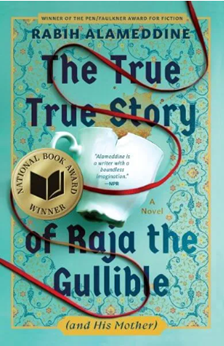
The True, True Story of Raja the Gullible (and his mother) by Rabih Alameddine.
Book Cover Picture
Genre or category
Comedy. Drama. Fiction. Coming of Age. LGBTQ+. National Book Award Winner.
Target Age Group
Ages 18 and up. (Grades 12 and up).
Summary
This is the story of Raja. Raja is a 63-year-old, homosexual, philosophy teacher who still lives with his mother. Raja’s mother, Zalfa, wants to know everything about his life, viewing his privacy as a problem. Eventually, Raja gets an invitation to America. But what starts as a stroke of goof fortune ends up leaving him to hope for the country he longed to escape from.
Justification
The reason I chose this book was that I wanted to read about a National Book Award winner. I also wanted to find a book that stood out from all the other winners. I wanted to find a book that was able to stand on its own two feet and talk about a book I have never read before. I wanted to find a book that was different from all the other books I have chosen and to be able to find something new within the text.
Evaluation
For this review, I will be evaluating the book’s tone, mood, and timeframe.
The book’s tone is mainly light-hearted and humorous. We see Raja talk about important historical events, but all he really wants to do is find his own way in life, and to escape from his overbearing mother. We see them banter from time to time in the book, like how he talks about his mother having a terrible memory. He says, “If there was an oblivion Olympics, you’d win a gold medal in every category.” (Alameddine, 2025, p.5). We see that Raja likes to exaggerate and by seeing him exaggerate, we get to understand how he sees the people in his life, such as his mother. We also start to see how others see him.
The next thing I would like to evaluate is the mood. I feel that the mood is based on Raja’s belief for longing. Longing for a better life, longing to be able to escape the nagging of his mother, and to see how he deals with loss. Especially near the end of the book once his mother finally passes away. He starts to feel helpless, and that he can’t do anything, leading to a major shift. We start to feel how lose Raja is, and we understand his rage and sorrow. When she dies, he feels that “the world should have raged, raged” and how he reflects on being “treated as a child and not a very bright one at that”. (Alameddine, 2025, pp.306). We start to feel what he is going through, and how he feels like an idiot for not being able to do anything about it.
Finally, I would like to talk about how the book handles historical events. Raja may not be a bright person, but he has lived though many events from his home country in Lebanon. From before the civil war, during the civil war, and even during the pandemic. He writes how many historical events have influenced him and his mother. From the start, we see how the pandemic “crushed any hope of changing the status quo.” (Alameddine, 2025, pp.61). In the same page we also see how the pandemic has changed them. Where Raja’s mother “needed people” and Raja “preferred to avoid them”. We see how the world has changed people, and how it forces the two characters who can’t stand each other to be forced together against their will, and there is nothing they can do about it.
References
Alameddine, R. (2025). The True, True Story of Raja the Gullible (and his mother). Grove Press.
Title of Book
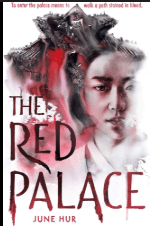
The Red Palace by June Hur.
Book Cover Picture
Genre or category
Historical Fiction. Mystery. Young Adult fiction.
Target Age Group
Ages 13-18 years. (Grade 8-12).
Summary
It is the Joseon Dynasty in 17th-century Korea. The young 17-year-old Hyeon has been invited to become a nurse for the imperial palace. However, she encounters the dark truth about court politics once four women have been mysteriously murdered, and her friend and mentor is considered the prime suspect. Suddenly, a young police inspector named Eojin joins the investigation. When the seemingly innocent crown prince is framed, Eojin and Hyeon must work together to find the culprit and prove the prince’s innocence.
Justification
I chose this book because I am particularly fond of East Asian History, and that I decided to choose that subject matter when looking for a historical fiction novel. I also wanted to see Asian history from the perspective of an Asian writer. OI chose this book because it looked interesting and may even teach me things about imperial Korea that I never knew before.
Evaluation
For this review, I will be evaluating this book’s use of the Korean language, historical background, and mystery.
Firstly, let’s see how this book uses the Korean language. While the book is in English, I do appreciate how it uses Korean slang and words within the text. Works like “Aigo!” which means “Oh My!” (Hun, 2022, pp.80). I also like how it uses words like “Hyeminseo nurse” which implies status or occupation. (Hun, 2022, pp,16). and Hyoen is referred to as Hyeon-ah by her peers, which is meant to be how Koreans may address each other the same way someone might say mister or miss. Overall, I feel the Korean language is used perfectly and can be told in a way that doesn’t confuse non-Korean readers. In fact, it educates the reader. Teaching proper Korean honorifics which help add to the setting, tone, and background of the story.
One other aspect I would like to talk about is the historical background. Taking place in historical Korea, it may be a tricky subject to follow. But the author uses an actual historical character to help add more context to how the Joseon dynasty lived. We hear of Crown Prince Sado, and how his tragic downfall in the story is based on his historical counterpart. By understanding Hyeon’s story, we can understand how the prince’s demise is by someone who desires power. A theme prevalent in all of human history. We see the death of a historical figure from the eyes of a commoner, and how she works to find the culprit. I recommend for anyone who wants to learn more about Korean History, as well as the regal couture of 17th century Korea.
The final aspect I shall find is the mystery. With the prince murdered, as well as other palace nurses, it ends up enthralling the reader and hooking them into the story. You want to know who did it, and you want Hyeon to succeed. You also want to see her relationship with Eonji blossom. Ove the course of the book, we are treated to a variety of suspects, and when one is the culprit, there is not enough evidence. The pages redirect the reader and keep them searching for more clues. That is what The Red Queen makes an exceptional story, and I highly recommend it to anyone who loves a good murder mystery.
References
Hur, J. (2022) The Red Queen. Square Fish. Feiwel and Friends, New York.
Title of Book
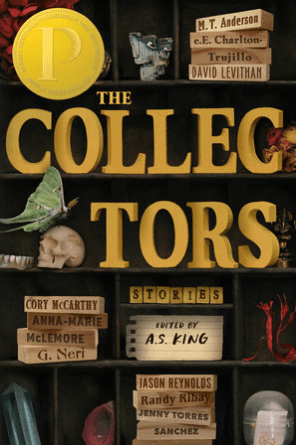
The Collector’s Stories. By Various Authors like M.T. Anderson, e. Charlton-Trujillo, A.S. King, etc. Edited by A.S. King.
Book Cover Picture
Genre or category
Anthology. Young Adult. Fiction. Printz Award Winner.
Target Age Group
Ages 14 and up (Grades 7th and up).
Summary
This book is a collection of young adult stories each represented by an object on a shelf. Through each object, we see a collection of short stories, pictures, poetry, prose, and dialogues.
Justification
I chose this book because I wanted to look for a Printz award winner. I also wanted to choose a book that represented many different stories. So, I chose this anthology. I wanted to see things from multiple perspectives, and I wanted to find a book that was different from the other Printz winners. I wanted a book that resembles a collection.
Evaluation
For this review, I will be evaluating this book’s organization, illustration, and themes.
Firstly, I will discuss the organization of the book. I liked looking through this book. I felt like entering a mysterious gift shop, or a museum of strange objects. It was like a collection of sorts. With each story representing a certain object in that collection. Some may appear more obvious than others, but they each are represented by an everyday object that stands larger than itself. Such as a candle representing the loss of a mother from a girl named Lucia (King et al, 2023, pp.85-86).
Next, I will talk of the illustrations that happen in the middle of the book. They talk of a “museum of misery” (King et al, 2023, pp.98). These pictures each represent themes of transphobia, depression, and government influence. Portrayed with skeletons and forced breathing exercises. But in the end, the gallery asks the reader to turn the book upside down and “change your perspective.” (King, et al 2023, pp. 132-133). The illustrations are insightful and full of detail. Helping to show the sorrow, loneliness, and hatred of people going through discrimination, bigotry, and hatred, all for being trans. So, the book is asking you to change your viewpoint and be able to accept all people for who they are.
Finally, I will be discussing the themes of this book. Each of these stories is different, but they all represent themes of acceptance, loss, and bigotry. But overall, the book had perfect themes for telling the reader that every story matters. Every person has their own experience, their own trauma, and their own way of finding their place in the world. Each of the short tales is different, and each tale is told in its own way, but it does not make any of them more important than the other. Every Person has their own voice, and their own perspective. So, they have the right to tell the world who they are, and we have the right to listen. I recommend this book to anyone who feels like an outcast, to anyone who likes short stories, and to anyone who likes an enjoyable read.
References
Anderson, MT, e.E. Charlton-Trujillo, Levithan, D., McCarthy, C., McLemore, A., Neri, G., Reynolds, J., Ribay, R., Sanchez, J.T., King, A.S. (2023). The Collectors: Stories. Penguin Random House LCC.
Title of Book
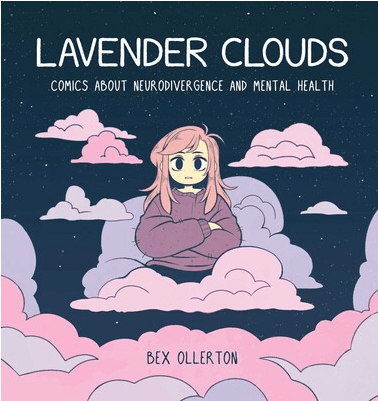
Lavender Clouds: Comics about Neurodivergence and Mental Healthy by Bex Ollerton.
Book Cover Picture
Genre or category
Young Adult. Graphic Novel. Neurodivergence.
Target Age Group
Ages 12 and up. (Grades 7th and up).
Summary
This book tells the story of Bex, and her experiences being an autistic woman. How she strives to blend in and walk among her peers, as an equal. The books tell her story through a series of comics that emphasize the uniqueness of neurodivergence, and how Bex sees the world.
Justification
I chose this book because I am autistic and I love graphic novels. So, I decided to choose a graphic novel that reflected on my struggles of being a neurodivergent person, and to see things from another neurodivergent perspective. I also chose this book because April is Autism Acceptance Month, a time to be proud of your neurodivergent behavior.
Evaluation
For this review, I will be evaluating this graphic novel’s art style, themes, and its portrayal of autism/neurodivergence.
Firstly, the art style is unique. It reflects the various cartoons of the 2010s which put their focus on diversity, acceptance, and individuality. This comic’s art style is based on these beliefs, as well as adding the author’s own personal viewpoint. We see shattered frames that represent anxiety, various panels that reflect the author’s desire to accomplish her goals, but to no avail. The colors also help to set the tone and mood. They are bright and colorful when Bex is feeling positive but becomes black and while once she is depressed or lost in her own mind.
Next, we shall analyze the themes. The main theme of this novel is the desire to love yourself and to feel accomplished, but sometimes your own doubts and behaviors can get in the way. Being an autistic person, Bex has a list of things to do, as well as the desire to do them, but not the effort. Bex just wants to be able to be proud of herself, but her habits keep getting in the way. We do want to see her succeed, and we see her go through a battle with her own mind to just get up and be able to care for herself.
Finally, we shall evaluate this book’s portrayal of autism and neurodivergence. While there are a lot of neurodivergent behaviors, the book focuses on autism. As an autistic person myself, I felt the same problems that Bex was going through. The desire to compete tasks, but you can’t because you are worried about how hard they are. To say to do something, but to only do so weeks later. To know a fun fact about an obscure TV show. I felt all these behaviors, and I feel it reflects the struggle neurodivergent people go through daily. The desire to be “normal” and to be able to convince yourself to get out of bed every morning. I recommend this book to anyone who wants to know more about autism or other neurodivergent behaviors. I also recommend this to people with neurodivergent backgrounds. I recommend this book to everyone who wants to understand the different behaviors of autism.
References
Ollerton, B. (2024). Lavender Clouds: Comics about Neurodivergence and Mental Healthy by Bex Ollerton. Andrews McMeel Publishing.
 Ramirez Book Blogs
Leave a comment